

Most businesses do not need a consultant to tell them what to build. They know their customers, their market and their problems better than any outsider. But there are moments when an outside view on product strategy is worth far more than it costs.
Here are the signs you have reached one of those moments, and a few signs you haven't.
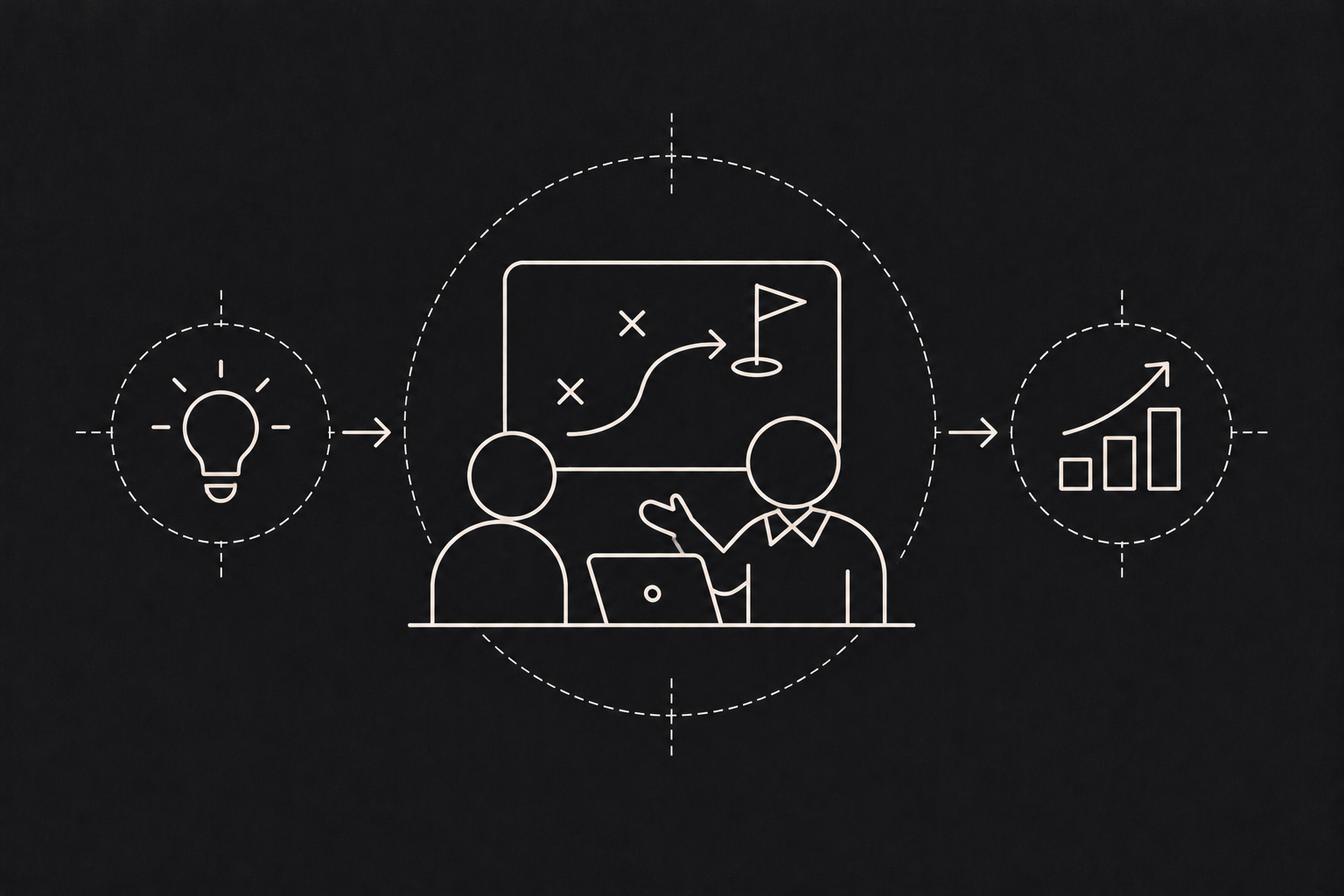
How a strategy engagement flows
- 01
Diagnose
Where are you now? Interviews and data.
- 02
Focus
Who do you serve best? Clear positioning.
- 03
Prioritise
What comes first? A roadmap with reasons.
- 04
Act
Build and measure with agreed success measures.
Signs you could use product strategy help
Your roadmap is a list of requests. Sales wants one thing, a big client wants another, the CEO has a new idea every week. Features get built, but nobody can explain how they add up to a clear direction.
You are building a lot but growth is flat. The team ships constantly. Usage and revenue do not move. That usually means effort is going into the wrong places. Pendo estimated in 2019 that public cloud software companies had invested up to $29.5 billion in R&D on features that went unadopted or underused.
You are planning a big bet. A new product, a new market, a move into another country, a shift from services to software. Decisions like these are expensive to get wrong and hard to undo.
Your team disagrees on what the product is for. If you ask five people in your company who the product serves and get five different answers, every decision downstream will be harder than it needs to be.
You have outgrown how you started. What worked with ten customers does not work with a thousand. Pricing, positioning, priorities and processes all need another look. You are digitising a traditional business. Moving from paper, phone calls or spreadsheets to software raises questions your team may never have faced: what to build versus buy, what to do first, how to bring staff and customers along.
If two or more of these ring true, a short strategy engagement is likely to pay for itself.
What good product strategy consulting looks like
It should leave you with clear decisions, not a thick report. Expect:
- A clear view of who you serve and what problem you solve for them better than anyone else.
- An honest look at your market and competitors, including the informal ones like spreadsheets and WhatsApp groups.
- Priorities with reasons. What to build next, what to stop, and what to leave for later.
- Measures of success your team agrees on, so you can tell whether the strategy is working.
- A plan your team can carry out without the consultant in the room.
The best engagements are collaborative. The consultant brings method and an outside view. Your team brings the knowledge of customers and the business. Neither works well alone.
When you probably don't need it
- You have a clear direction and the product is growing. Keep going.
- The real problem is execution capacity, not direction. You need more builders, not more planning.
- You want someone to confirm a decision you have already made. That is validation, not strategy, and it rarely helps.
Questions to ask before hiring a consultant
- Have they worked on products like yours, or in markets like yours?
- Will they talk to your customers, or only to your leadership team?
- What exactly will you have at the end?
- Can they help you act on the strategy, or only write it?
That last question matters more than it seems. Strategy that never turns into a product is just a document, no matter how polished it looks.
How long an engagement usually takes
Most focused strategy engagements run for a few weeks rather than months. The early part is listening: interviews with your team and your customers, and a look at your data. The middle part is making choices together. The final part is turning those choices into a plan with owners and dates. If an engagement has no clear end point and no defined outputs, ask why before you sign.